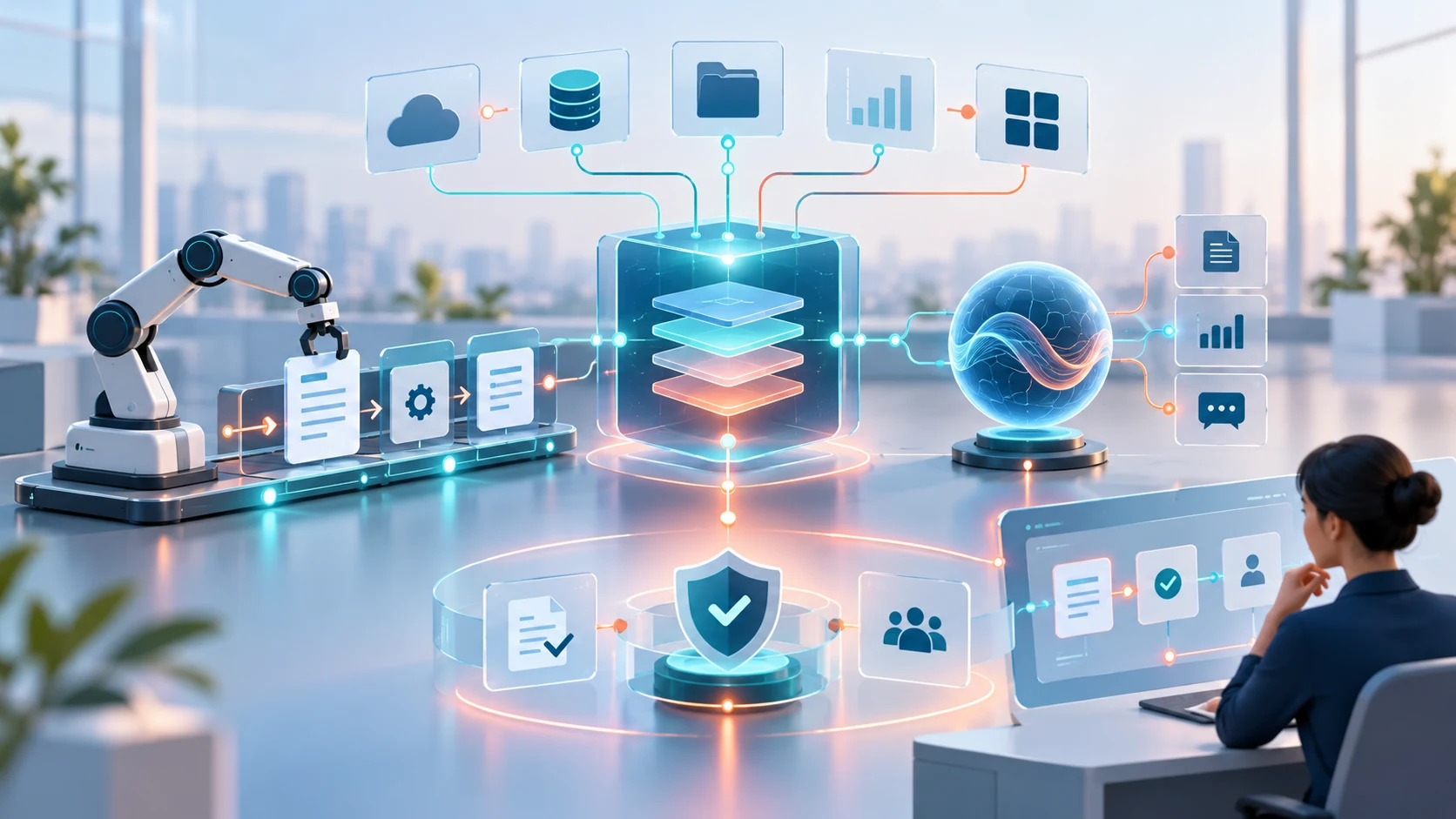
For years, robotic process automation (RPA) has handled the repetitive digital work that follows clear rules: moving information between systems, processing invoices, updating records, or preparing reports. These software bots are useful because they repeat defined steps consistently. But traditional RPA can struggle when a task involves messy documents, changing screens, or judgment calls.
The latest shift is to combine RPA with AI agents. An agent can interpret less structured information, decide which step may be needed next, or route an exception. An RPA bot can then carry out precise actions in a desktop or legacy application. A person can review sensitive decisions or cases that fall outside policy. Together, these pieces can cover more of a process than any one can handle alone.
What is changing in 2026?
Microsoft’s 2026 Power Automate release plan describes a move toward more AI-assisted desktop automation, including agent support for authoring and optimizing flows, and self-healing capabilities intended to help automations adapt when systems change. The plan also describes connecting AI agents to desktop flows when work needs precise, step-by-step execution. These capabilities point to a broader design pattern: let AI help with flexible tasks, while RPA provides a controlled way to interact with existing applications. [Microsoft’s 2026 release plan](https://learn.microsoft.com/en-us/power-platform/release-plan/2026wave1/power-automate/)
Industry surveys show both strong interest and a gap between ambition and deployment. Camunda’s 2026 survey of 1,150 IT leaders, business decision-makers, and software architects found that 73% saw a gap between their agentic AI vision and current reality; 79% planned to increase automation spending. UiPath’s 2026 trends report says 78% of surveyed executives believe they will need to reinvent operating models to capture the full value of agentic automation. These are vendor-sponsored surveys, so the figures are best read as indicators of reported priorities, not universal forecasts. [Camunda’s 2026 report](https://camunda.com/state-of-agentic-orchestration-and-automation/) · [UiPath’s 2026 report](https://www.uipath.com/resources/automation-whitepapers/automation-trends-report)
A practical example: invoice processing
Imagine an invoice arriving as a PDF with different layouts and naming conventions. An AI component can extract the supplier, amount, and payment terms, then flag uncertain fields. Business rules can check the values against purchase orders and company policy. An RPA bot can enter approved details into an older finance system that has no convenient integration. If a mismatch or high-value payment appears, the workflow can pause for an employee’s review and record who approved it.
This approach keeps the strengths of RPA while extending automation into work that used to require more manual sorting. It also avoids asking an AI model to make every decision or control every click.
The hard part is trust and oversight
A successful pilot is not automatically ready for daily operations. Teams need to know what data an agent used, what action it took, which policy applied, and when a person must step in. They also need monitoring, access controls, recovery plans, and a clear owner for each workflow. Camunda’s report highlights the distance between agent experiments and production use, reinforcing that governance and orchestration are core parts of the work—not finishing touches.
A sensible starting point is one process with measurable volume, stable rules, and a clear exception path. Map the process before automating it. Use APIs where they offer a reliable connection; reserve desktop RPA for tasks that still require interaction with a user interface. Add AI only where it improves a defined step, set confidence thresholds, and send uncertain or high-impact decisions to a person. Then track completion time, error rates, exception volume, and the amount of human review.
The next chapter of RPA
RPA is becoming one component in a broader automation toolkit. AI agents can interpret and coordinate; bots can perform repeatable actions; people can provide judgment and accountability. The organizations that make this combination work will be the ones that design the full process around reliability, measurement, and oversight—not simply add an agent to an existing bot.